

Elastomer Terminology
O-Ring Standard Size Chart


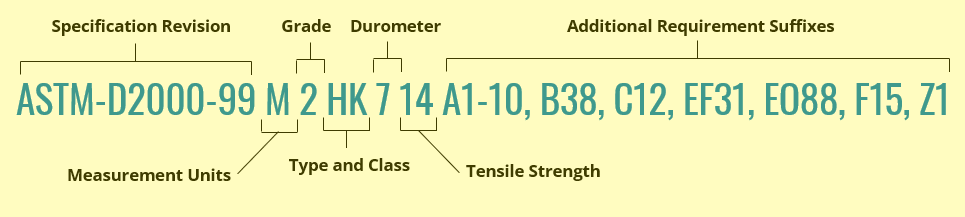
Interpreting an ASTM D2000 Line Call-Out:
Each line call-out comprises different segments, each representing certain specifications of the material. To guide this understanding, we will use the above example.
This line call-out contains 7 different segments that this guide will walk through:
- The Specification Revision
- Measurement Units Identification
- Grade Number
- Type and Class
- Hardness or Durometer
- Tensile Strength
- Additional Requirement Suffixes
1. Specification Revision
The first part of the line call-out is the specification revision. This refers to the revision year of D2000 to which the line call-out makes reference. For this example, ASTM-D2000-99 is the specification revision. The “-99” at the end of the standard number indicates the year (1999) when this specific version of the standard was either issued or reaffirmed.
2. Measurement Units
The next part of the ASTM line call-out indicates the units that will be used. If an M is present in the line call-out, it indicates that metric units will be used to measure tensile strength, temperature, and tear strength (MPa, °C, and kN/m, respectively). If no M is present, English units will be used (psi, °F, and ppi, respectively). For our example, the measurements will show in metric units.
3. Grade Number
The grade is specified following the unit of measurement specification (or the specification revision in the case of English units). This indicates the extent of testing requirements that a material may undergo. Grade 1 signifies that only fundamental properties are necessary, whereas Grades 2-9 necessitate additional testing criteria, such as assessments for low-temperature brittleness or specialized heat aging. In our example, the material must conform to some or all of the Grade 2 requirements. It's important to note that Grade Numbers may not be applicable to all material Types and Classes.
4. Type and Class
The Type and Class constitute a crucial component of an ASTM D2000 call-out. A Type is identified by a single letter following the Grade number. The Type signifies the elastomer's tensile strength characteristics after undergoing heat aging at a specified duration and temperature. The single letter that follows the Type is referred to as the Class, representing the elastomer's resistance to swelling after immersion in ASTM Oil for a specified duration and temperature. When considered together, the Type and Class provide information about the polymer. In our example, the Type and Class are "HK," which indicates fluorinated elastomers such as Viton® or Fluorel.
The below table has the most common polymers used for each type:
|
Classification System D2000 SAE J200 Material Designation (Type and Class) |
Most Common Used |
|
AA |
Natural rubber, reclaimed rubber, SBR, butyl, EP polybutadiene, polyisoprene |
|
AK |
Polysulfides |
|
BA |
Ethylene propylene, high temperature SBR, butyl compounds |
|
BC |
Chloroprene polymers (neoprene), cm |
|
BE |
Chloroprene polymers (neoprene), cm |
|
BF |
NBR polymers |
|
BG |
NBR polymers, urethanes |
|
BK |
NBR |
|
CA |
Ethylene propylene |
|
CE |
Chlorosulfinated polyethylene (Hypalon), cm |
|
CH |
NBR polymers, epichlorohydrin polymer |
|
DA |
Ethylene propylene polymers |
|
DE |
CM, CSM |
|
DF |
Polyacrylic (butyl-acrylate type) |
|
DH |
Polyacrylic polymers, HNBR |
|
EE |
AEM |
|
EH |
ACM |
|
EK |
FZ |
|
FC |
Silicone (high strength) |
|
FE |
Silicones |
|
FK |
Fluorinated silicones |
|
GE |
Silicones |
|
HK |
Fluorinated elastomers (Viton®, Fluorel, etc.) |
|
KK |
Perfluoro elastomers |
5. Hardness (Durometer)
Hardness or Durometer measures a material’s resistance to permanent indentation or deformation. It is often used as a proxy for the overall flexibility or rigidity of a material. It’s one of the key properties specified in ASTM D2000 line call-outs. Hardness is typically measured using the Shore A scale in the context of rubber or elastomeric products. The Shore A Durometer is the most common device to measure the hardness of elastomers, rubber, plastics, and non-metallic materials. For context, a rubber band may have a hardness around 25 Shore A, a car tire around 70, and a hard plastic skateboard wheel around 98 Shore A. The hardness of a material can impact its performance in applications, so understanding the durometer number in the ASTM D2000 specification can help in selecting the right material for your specific needs. For instance, a harder material might resist abrasion or deformation better but could also be less flexible.
In your ASTM D2000 line call-out, the hardness value is represented by the first digit after the Type and Class (“HK” for our example). Here the number is “7”, which refers to a hardness of 70 in Shore A units (±5). This means the material should have a hardness between 65 and 75 on the Shore A scale.
6. Tensile Strength
In an ASTM line call-out, the tensile strength immediately follows the durometer, and the unit of measurement (MPa or psi) is denoted by the presence of an “M” after the Specification Revision. If the measurements are in English units, the digits show psi, and only the first two digits of that measurement are indicated. In our example, the material’s tensile strength is 14 MPa. If this example were non-metric, the callout would be 20 (14 MPa = 2031 psi).
Tensile strength refers to the maximum amount of tensile (pulling) stress a material can withstand before falling or breaking.
In the context of elastomers used in sealing applications, this parameter plays a critical role, as it significantly impacts their performance under pressure and their overall durability. A higher tensile strength typically indicates a stronger and more robust material, while a lower tensile strength may suggest a softer and more flexible one. Nevertheless, it's vital to bear in mind that tensile strength alone does not provide a comprehensive assessment of a material's suitability for a specific application. It is just one of several properties, including hardness, elongation, and resistance to specific environments, that must be taken into account when selecting a material for a particular use case.
The first six characters of a line call-out give a lot of basic information about the type of elastomer required and its physical properties. Most specifications require more information to guarantee that the seal will meet the needs of the application.
7. Additional Requirement Suffixes
Suffixes are a combination of letters and numbers that indicate a material’s test and performance criteria. Each letter-number pair corresponds to a specific requirement. In our example, these requirement suffixes are A1-10, B38, C12, EF31, EO88, F15, and Z1. The suffixes indicate a heat resistance test, compression set test, resistance to ozone, fuel resistance, oil and lubricant resistance, low-temperature brittleness criteria, and a special criteria that must be specified in detail, respectively.
Below is a list of suffix call-out details. Refer to ASTM D2000 for expanded suffix call-out details.
|
Suffix Letter |
Test Required |
|
A |
Heat Resistance |
|
B |
Compression Set |
|
C |
Ozone or Weather Resistance |
|
D |
Compression-Deflection Resistance |
|
EA |
Fluid Resistance (Aqueous) |
|
EF |
Fluid Resistance (Fuels) |
|
EO |
Fluid Resistance (Oils and Lubricants) |
|
F |
Low-Temperature Resistance |
|
G |
Tear Resistance |
|
H |
Flex Resistance |
|
J |
Abrasion Resistance |
|
K |
Adhesion |
|
M |
Flammability Resistance |
|
N |
Impact Resistance |
|
P |
Staining Resistance |
|
R |
Resilience |
|
Z |
Any Special Requirement (Specified in Detail) |
